
If you could meet a historical figure, who would it be and why?
Choosing Paul, Learning from Saul, and Letting Christ Live Where It Matters Most
I used to treat the question, “Which historical figure would you like to meet?”, like party trivia.
Pick your favorite:
Jesus (gold-star answer),
Lincoln (safe),
Rumi (mystic points),
Van Gogh (artistic flex),
or Da Vinci (for people who want you to know they read).
Say something clever, sip your coffee, move on.
But the older I get, the simpler—and more unsettling—my answer becomes.
If I could sit with anyone from history, I would choose Paul…
because the man he used to be—Saul—still startles me.
Not the cartoon villain.
The real one:
brilliant, disciplined, admired,
and convinced he was serving God
while walking in the opposite direction of God’s heart.
And here is what I keep returning to:
The real miracle was never the blinding light.
It was the yielding that came after.
Anyone can be knocked down by revelation.
Only a transformed man can rise slowly and walk in a new direction.
Years ago, Dr. Marc unpacked two Greek words we tend to skip:
idiōtēs — the ordinary one, unimpressive.
moros — the fool for Christ.
God built His kingdom on idiots and morons (in the biblical sense):
ordinary people who let God be the extra in their ordinary—
and in doing so, became extraordinary without ever trying.
Saul was not an idiot.
He was too shiny for his own good.
Too accomplished to be teachable.
Paul became willing to be foolish in the right direction.
And the truth is:
I recognize pieces of both men in myself.
Below are three scenes where the clay still turns
and Christ keeps inviting me from Saul-shaped striving
into Paul-shaped surrender.
I. The Sleeping Girl and the Working One
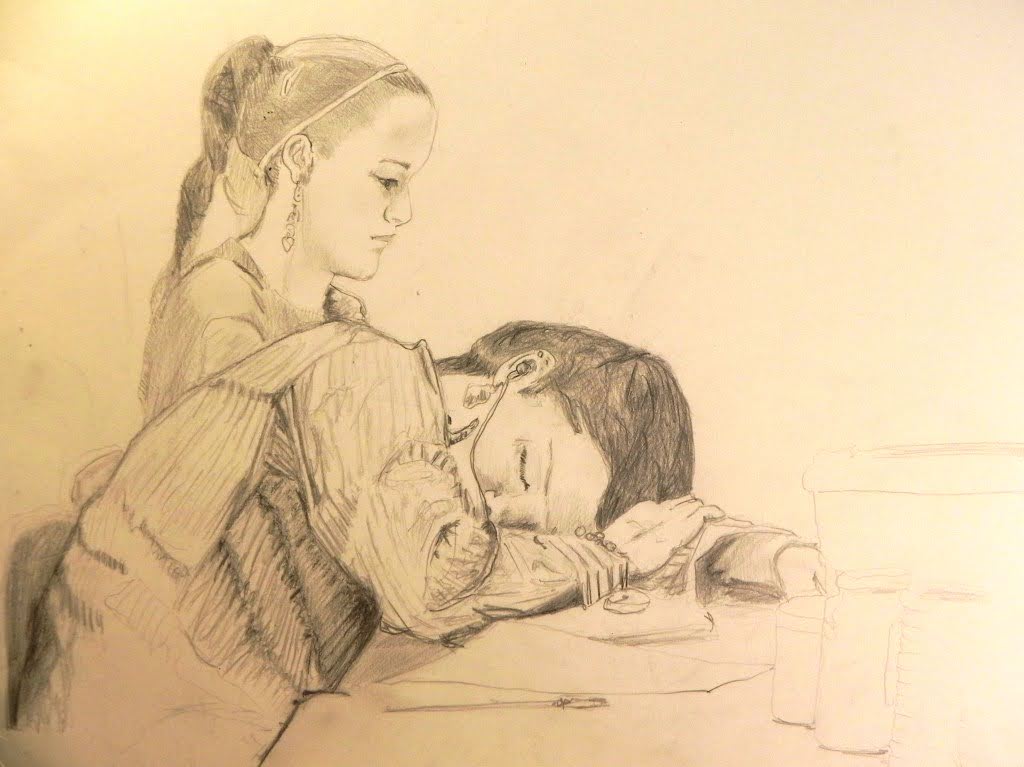
Years ago, in an eighteen-week clay class,
I drew two students:
Tatum — steady, focused, hands deep in the clay.
Melonie — face down on folded arms, fast asleep.
On paper, it looked like a morality tale:
Hard Work vs. Laziness.
Saul would have loved that version—
he lived by categories and clean lines.
But Melonie was not rebelling.
She was simply… Melonie.
Probably up too late with friends,
a free spirit,
laughing when she was awake.
And because my classroom has always been a safe space
to work hard or to crash from yesterday,
I let her sleep.
No speech.
No reprimand.
Just unplanned mercy.
Looking back, I see it clearly:
My instincts were kinder than my theology.
I believed in a God who rewarded effort.
But I served a God who let tired kids sleep.
Saul would have written a policy.
Paul would have recognized grace.
II. The Hand on the Wheel
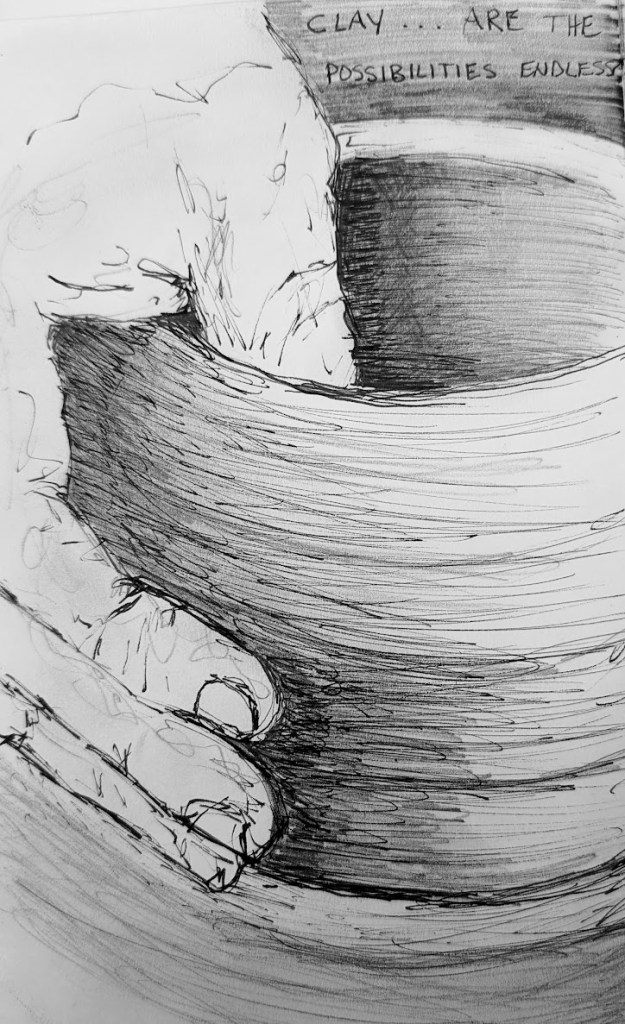
In that same sketchbook is another scene:
a single hand pressing into a spinning wall of clay.
Above it I wrote,
“Clay… are the possibilities endless?”
We preach Saul’s conversion like lightning—
but lightning only cracks the pot.
It does not reshape it.
The real transformation is the wheel—
the turning,
the pressure,
the slow undoing of old instincts.
This is where Dr. Marc’s old riff meets Paul’s life:
God is not recruiting spiritual experts.
He forms idiōtai — ordinary people — into vessels of glory
by being the extra in their ordinary.
Saul tried to be extraordinary for God.
Paul let God be extraordinary in him.
That is the work happening in me too.
My thoughts spin.
My worries harden.
My excuses hold their shape.
And still—the hand presses.
Patient.
Persistent.
Reforming me from the inside out.
III. The Child With Witnesses

Lucy lies on the floor coloring rockets and planets.
Around her sits her small congregation of stuffed animals—
creatures whose seams carry our whole family story.
She is fully absorbed.
The stuffies quietly witness.
Lucy is not performing.
She is creating in front of witnesses she trusts.
Her audience asks nothing of her—it simply sees her.
Somewhere along the way, I drift from that truth—
trading stuffed animals for supervisors,
friends for critics,
simple joy for anxious self-inspection.
This is where Saul lived his whole life:
under an imagined audience —
a crowd he believed he had to impress
in order to matter.
Paul learned something Lucy already knows:
Creation is not performance.
Witness is not judgment.
Presence is not pressure.
Maybe the Spirit is returning me to that floor beside my children—
where joy is unmeasured,
belonging is assumed,
and being seen is a gift, not a test.
The One Question That Will Matter
I do not fear hell.
I fear arriving before Jesus with a résumé and a speech,
only to hear:
“Yes… can I help you?
And you are…?”
I do not want a first meeting.
I want a continuation.
A life that already knows the voice
that let Melonie sleep,
kept His hand on my clay,
and knelt beside my children
while I drafted shinier plans.
And here is the line that keeps echoing:
Anyone can fall to the ground in bright light.
Yielding is the real miracle.
Falling is spectacle.
Yielding is formation.
Yielding is what lets Christ live in us.
Saul defended an idea of God.
Paul was undone by the Person.
And if Paul and I sit across from each other someday,
I know the question he will ask—
the question everything hangs on:
“Did you let Christ live in you?”
Because if the answer is yes,
everything else—
mercy, gentleness, courage,
holy foolishness—
flows from that spring.
I Wonder…
Where are you still living like Saul—
brilliant, driven, and wrong in familiar ways?
Where is the potter’s hand pressing
on a place that does not want to yield?
What childlike part of you
still lies on the floor coloring,
hoping someone is watching?
I do not want to be the smartest fool in the room.
I want to be the man who let himself be remade—
slowly, quietly, stubbornly—
under a Hand that never gives up.
And if I meet Paul someday,
I hope we can agree:
We stopped defending God for Him
and finally let Christ live in us
until His voice
felt like home.
Tags: #SaulToPaul #Formation #ClayOnTheWheel #ChristInYou #SpiritualReflection #TeachingLife #GraceInTheClassroom #ChildlikeFaith #BecomingHuman #DrMarc #WordPressCommunity
 Forming 2.0
Dean,
This one stopped me in my tracks.
Your line about not wanting to be “the smartest fool in the room” caught something in me too. I’ve spent years trying to get things right, say things right, be right only to realise how easily that becomes Saul’s kind of brilliance: sharp, disciplined, impressive… and still missing the center.
Reading this, I found myself quietly asking, “Where am I still performing? Where am I still resisting the hand on the wheel?”
The way you hold the contrast between Saul’s striving and Paul’s yielding feels like a mirror I wasn’t expecting today. That shift from managing God to letting Christ live in us—feels like the hardest and most necessary unlearning.
What moved me most was how ordinary the moments of formation are in your stories: a tired student sleeping, a potter’s hand pressing, a child coloring without fear of being watched. That’s exactly where I get it wrong most often trying to be smart in places where God is simply asking me to be soft.
I don’t want to be the smartest fool either.
I want to be someone who finally stops defending God for Him, and lets myself be remade in ways that are slow, quiet, and real.
Thank you for writing this. Your words keep reorienting me in ways I didn’t know I needed.
Ulrich
LikeLiked by 2 people
Ulrich, as I sit with your words, I find myself reflecting more deeply on what I actually said. You help sharpen my thinking and keep me honest in my own authenticity. Thank you for your witness here. Your presence and the way you show up matter.
-Dean
LikeLiked by 2 people