


Sometimes the best memories are made when we lose what we thought we needed.
Some of my earliest camping memories feel almost mythic now.
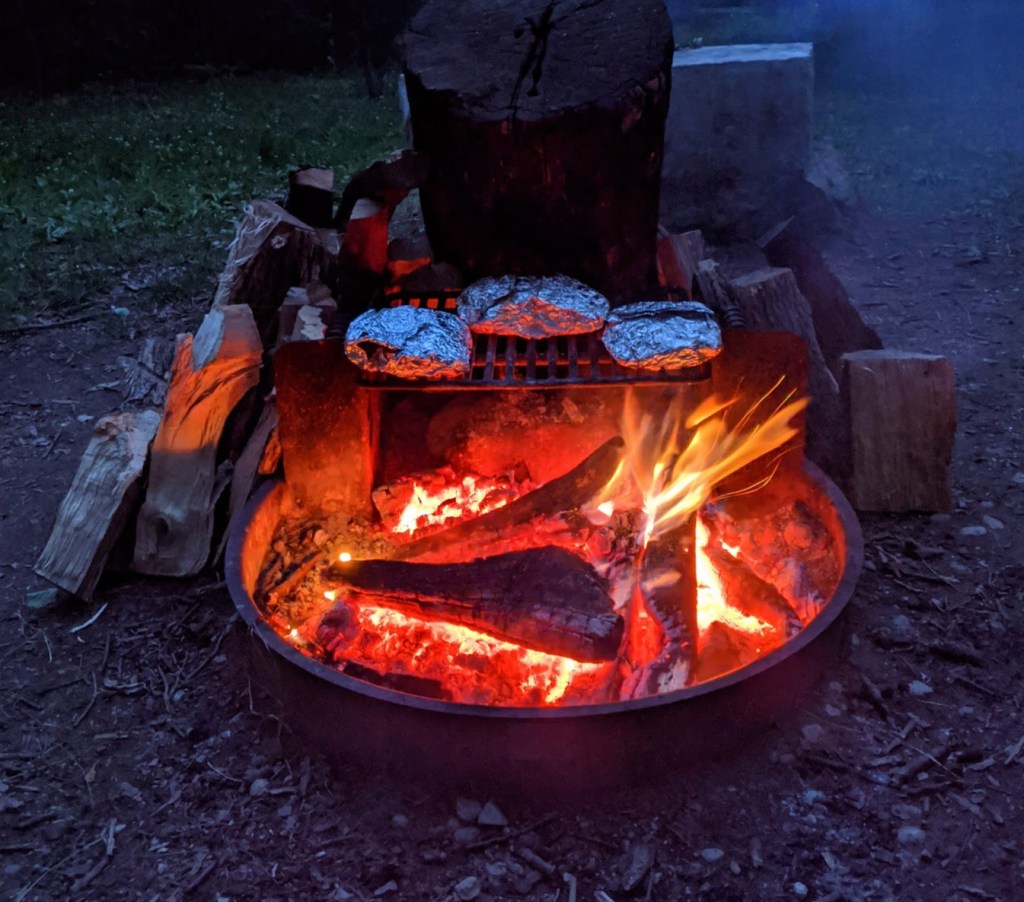
We had a heavy canvas tent that reminded me a little of a circus tent—likely something my father hauled back from his time in Korea. We slept on military cots, the kind that creaked under our weight. We caught fish from the lake, and by evening, the smell of butter, lemon, onions, and potatoes wrapped in foil on the fire filled the air with something sacred.
Family gathered around the fire, roasting marshmallows, sticky fingers reaching for one more, sipping lemonade—or something stronger for the adults—until the stars blinked on overhead. By nightfall, sleep came easy, not because conditions were perfect, but because we had poured ourselves out in the work of creating a few moments away from the busyness of work, school, and crowds.
As I grew older, camping took on new shapes, but its lessons stayed stubbornly the same.
In college, a friend and I set out on a rugged adventure: biking 35 miles to the edge of a peninsula, catching a boat to a small island, hiking 9 miles across it, then taking another boat to an even smaller island, and hiking one final mile to our campsite. Two pup tents. One tiny fire. Endless sky overhead.
We swam in Lake Michigan, numb and breathless from the cold. When a salmon swam between my legs, I scooped it onto the shore, and my friend dispatched it with a rock. A neighboring camper, drawn by the smell of roasting fish, offered a trade: a cup of rice for a portion of our salmon. We accepted gladly and steamed wild greens we’d foraged along the way.
It remains one of the best meals I’ve ever eaten—no garnish, no centerpiece, just hunger, gratitude, and open sky.
We stumbled across old cemeteries too—crumbling stones whispering of lives long gone. One marker claimed the grave of Daniel Boone’s brother. We sat there, young men too full of questions to find many answers, yet comforted by the way life layered itself across those quiet, forgotten places.
Funny how memory sweetens the struggle.
I barely remember the weight of the gear or the mosquitoes.
But I remember the fire. The conversation. The way life felt stripped down and honest.
Not every camping memory glows with nostalgia, though.
One trip with my young family ended near midnight, flooded out by a torrential downpour.
We had packed all the wrong things—creature comforts that made us less flexible, less willing to bend when nature pushed back.
Tensions ran high. Tears fell.
It’s not a memory I linger on.
Yet even there, lessons hid beneath the soggy sleeping bags.
My wife, Lindsey, grew up camping too, but her version was different from mine.
Our early trips together exposed fault lines: what to bring, what to leave, what to endure, what to avoid.
But to her credit—and to our shared growth—she saw discomfort as an invitation to connect, not a reason to pull away.
Over time, we forged new traditions.
I learned to bring less into the woods.
She embraced bike rides that didn’t end at an ice cream shop.
We adapted. We grew. We carried less.
Some lessons land with less poetry.
On a trip with my son Gibby, after a day of good weather and better fishing, I roasted a fish over the fire, just as my mother used to—foil packets with butter, lemon, and a pinch of salt. Passing that fish to Gibby, my hands still smelling of smoke, I felt the quiet joy of giving him something real: not convenience, but connection.
Then humility arrived, as it often does.
I had left the car radio on while packing up, listening to a favorite program.
By the time we were ready to leave, the battery was dead.
We waited hours until a ranger gave us a jump—hours of sitting side by side, watching the trees sway in the late afternoon light, letting the world slow down around us.
In the end, these experiences—glorious and messy, sacred and ridiculous—taught me something simple and stubborn: we pack too much.
Not just in our backpacks, but in our lives.
We carry old expectations, illusions of control, comforts that weigh us down more than they lift us up.
We try to make the wilderness feel like home instead of letting it make us more at home in ourselves.
Søren Kierkegaard wrote that a sailor cannot steer by the ever-shifting waves—they rise and fall too fast.
He must navigate by the stars, steady and unchanging.
Yet even the stars are not eternal.
Only the One who made them—the Word that endures forever—can anchor a life through the tides.
The world offers waves: comfort, security, control.
Jesus offers stars: truth, sacrifice, surrender.
Camping has taught me, often through my own foolishness, to travel light and navigate by the stars that point to something greater.
So here’s to packing light.
To setting up camp with fewer expectations and more open hands.
To finding home not in what we bring, but in what we discover along the way.
And maybe the wilderness isn’t what delays us.
Maybe it’s what forms us.
What’s something you thought you needed—but realized you didn’t—once you pitched your tent for a while?
#CampingMemories #LifeLessons #TravelLight #FaithJourney #LivingFromTheInsideOut #WildernessWisdom #SimpleLiving #SpiritualFormation #FamilyTraditions #Forming2point0
 Forming 2.0
Leave a comment